The First Word Was Read


A note before we begin. I do not write this as a Muslim. I am Persian, and my roots run back to Zarathustra, to the fire that in my view shaped the moral imagination of every faith that came after it. I come to this text the way a man reads the map of a country he did not grow up in but knows the terrain of, with respect and with open eyes. I am writing mainly for those who call themselves Muslims, because it is their book and their inheritance I am asking about. Anyone else is welcome to read over our shoulder. I only ask one thing of whoever reads this, and it happens to be the same thing the book itself asks first. Read.
Start with the moment the whole thing begins. A man sitting in a cave outside Mecca, in a place and a century the tradition itself calls jahiliyyah, the age of ignorance. He is forty years old and he cannot read. An angel takes hold of him and gives him one word.
Iqra.
Read.
Not obey. Not submit. Not cover. Read. The first syllable of the entire religion is a command to gain what you do not know. The passage that follows, the opening of chapter 96, tells him that his Lord taught by the pen, taught the human being the thing he had no way of knowing on his own. The first revelation, dropped into a society the text describes as drowning in ignorance, chooses to lead with knowledge and the pen. That is not a small detail. That is the founding gesture. The religion opens by commanding the exit from ignorance through learning.
I keep that in front of me, because everything I am about to lay out follows from it. If the first command was to read, then reading is not a betrayal of the faith. Reading is the faith doing what it was born to do. And when you actually read, carefully, at the source, on the question of the veil, you find something most people have never been told.
What the text actually says about covering
There are two words people confuse. One is hijab. One is khimar. They are not the same, and the difference is the ballgame.
Take hijab first, because it carries all the weight in modern speech and none of it in the text. The word appears in the Quran seven times. In chapter 7 verse 46, chapter 17 verse 45, chapter 19 verse 17, chapter 33 verse 53, chapter 38 verse 32, chapter 41 verse 5, and chapter 42 verse 51. Go and look at every one of them. Not a single one is about a woman's clothing. The root of the word means to separate, to screen, to partition. It is a barrier between two things.
The verse people actually point to is 33:53, and it is worth seeing what it is really about. The believers are told not to wander into the Prophet's house uninvited, not to linger after a meal, and when they ask his wives for something, to ask them from behind a hijab. That is a curtain hung in a house. A physical screen between the men in the room and the women behind it. It is a rule about manners in one specific household, and the word means the drape on the wall. It has nothing to do with a scarf on a head. The collapse of hijab into headscarf happened later, in the law books and then in ordinary speech. The book itself never made that move.
So where does the idea of covering come from at all? From a different word, in 24:31. This is the verse that matters, so slow down and take it apart.
The instruction to the believing women is to lower their gaze, guard themselves, and not display their zinah, their adornment or finery, beyond what is already apparent. Then comes the operative line, the one everything turns on:
wal-yadribna bi-khumurihinna ala juyubihinna
and let them draw their khumur over their juyub
That is the entire command about covering. Six words in the original. Now take the two that carry the weight.
The first is khumur, the plural of khimar. A khimar was a piece of cloth women in that time already wore over the head and let hang down the back. It was ordinary dress, worn before Islam and after it.
The second is juyub, the plural of jayb. It means the opening of the garment at the chest, the bosom, the neckline.
Here is the picture the words are painting. The tunics of that time were cut with a wide opening at the front. A woman wore a cloth over her head that fell behind her, and her chest was left bare or nearly bare. The command is to take the cloth that is already on your head and pull it across the opening at your chest. Cover the bosom. That is the instruction. The word for hair, sha'r, is nowhere in the verse. The word for head, ra's, is nowhere in the verse. The command names the chest, and only the chest, because the chest was the thing being exposed.
Even one of the most respected modern translators, Muhammad Asad, admits this in plain language. He writes that the khimar was a head-covering women already used, worn loosely down the back, and that because the tunic left the breasts bare, the point of the verse was to cover the bosom, not to make the head-covering itself into a law. The cloth is the tool that happened to be at hand. The chest is the target. When a text tells you to cover one part of the body and stays silent on the part right above it, the silence is not an oversight. If the hair were the point, the same sentence that took the trouble to name the bosom would have taken the trouble to name the hair.
Why the chest, and not the hair
This is where the history most people are handed and the history a person can actually defend start to part ways, so let me be honest about both.
The pre-Islamic period is called jahiliyyah, the age of ignorance, by the tradition and by the Quran itself. When you read the commands that came down in Medina, a pattern shows up. Again and again the text is reforming a specific ignorant behavior of that exact time and place.
Look at the marriage rules in chapter 4. Verse 22 tells men not to marry the women their fathers had married. Verse 19 tells them they cannot inherit women against their will. These were not abstract morality lessons. They were revealed against a real custom. When a man died in that society, one of his sons could inherit his father's widow the way he inherited a camel or a field. He would throw a cloth over her to claim her as property, and then he could marry her with no dower, or lock her away, or sell her marriage to someone else and pocket the payment. The commentary tradition ties these verses to an actual case, a woman whose stepson inherited her and refused to support her, who went to the Prophet, and the verses came down in answer. The text is legislating against a named, ignorant practice.
Now apply the same logic to the chest. The commentary says the point of covering the bosom was to make the believing women different from the women of the jahiliyyah, who walked in front of men with their chests uncovered. Same mechanism. A specific behavior of that time, exposed breasts in public, and a command that reforms it.
That is the whole case. The instruction to cover the chest makes complete sense as a response to a circumstance. It makes no sense as a timeless metaphysical statement about a woman's hair, because hair was never the behavior being addressed. Covered hair was already normal. The uncovered chest was the problem. The verse solves the problem in front of it and says nothing about hair because hair was not on the table.
I will give the other side its due, because I want this to be honest and not a sermon in the other direction. The classical commentators, Ibn Kathir among them, do read hair-covering into the verse. They say the khimar covers the head and that believing women were meant to differ from the jahiliyyah women whose necks and hair and earrings showed. That reading exists. My argument is not that no one ever claimed it. My argument is that the claim is a layer laid on top of a text that does not say it, and to see how that layer got there, you have to look at how the text itself was fixed on the page.
The dots came later, and human hands put them there
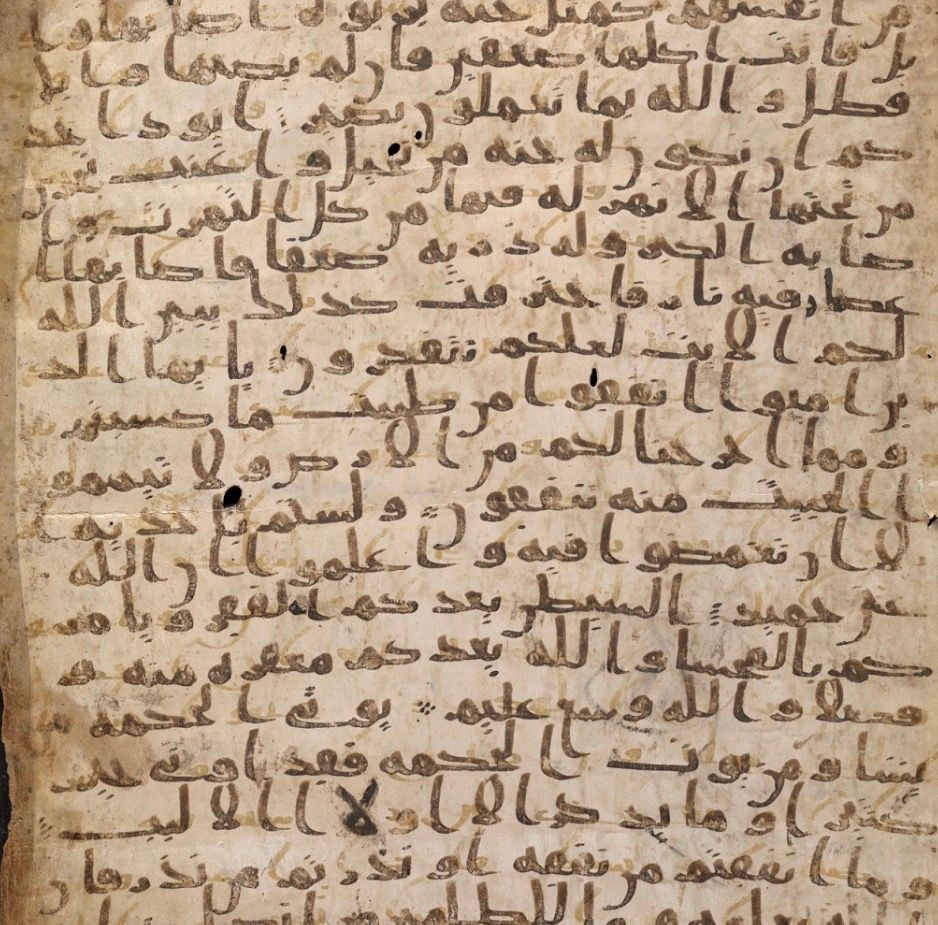
This is the script in its earliest form, before the dots and vowel marks were added. Even a fluent Arabic reader today cannot read it with certainty from the page alone.
Here is the part almost no one talks about, and it is the part that ties everything together.
The oldest Qurans we have, written on parchment in the Hijazi script in the seventh century, carry only the bare bones of the words. The consonantal skeleton. Arabic in that raw form is dangerously open. The same shape can be a b, a t, a th, a n, or a y, depending on dots that were used rarely and inconsistently in the earliest manuscripts. And there were no vowel marks at all. None of the fatha, kasra, and damma that tell you how a word is actually pronounced and therefore what it actually means. The skeleton was written first. The marks that lock down the meaning were not there yet.
They were added later, by named men, in two separate waves, and you could see it happening because the marks were put down in a different color of ink.
The vowel layer came first. Abu al-Aswad al-Du'ali, who died around the year 688, is credited with the first system. He used colored dots. A dot above a letter for the "a" sound, a dot below it for "i," a dot in front of it for "u," and two dots for the nasal ending. This work was done under the Umayyad caliph Abd al-Malik ibn Marwan, because there was an urgent problem to solve. People were reciting the text wrong and changing its meaning.
The story they tell about why al-Du'ali took up the work is the single best illustration of the stakes, so keep it. Someone reciting chapter 9 verse 3 mispronounced one word. He read rasulihi where he should have read rasuluhu. One vowel. That one vowel flipped the meaning of the sentence from "God disavows the idolaters, and so does His Messenger" into "God disavows the idolaters, and disavows His Messenger." One dot in the wrong place turned God into someone who repudiates His own prophet. Al-Du'ali's reaction was, God forbid, God cannot disavow His Messenger, and that is when he agreed to start marking the text. Sit with that. The meaning of the revelation, at that level of detail, hung on a mark that a man decided to add a generation after the words were written down.
The second wave was the consonant dots, the ones that separate the b from the t from the n. Al-Du'ali's large dots were clumsy, so the work of building a cleaner system fell to the Umayyad governor of Iraq, al-Hajjaj ibn Yusuf. He commissioned two of al-Du'ali's own students, Nasr ibn Asim, who died around 707, and Yahya ibn Ya'mar, to do it.
Read that name again. Al-Hajjaj was not a saint and not a scholar. He was a provincial governor, one of the most feared enforcers the early Islamic state ever produced. The apparatus that settled how the Quran is read was commissioned, in part, by raw political power. That is not my theory. It is in the standard sources, sitting in plain sight.
And the men who did this work were the same grammatical culture I wrote about last time. Abu al-Aswad is called the father of Arabic grammar, and the grammar was built through the study of the Quran. A century later Sibawayh, the Persian, was studying the surviving treatises of that school when he wrote the Kitab, the book that fixed Arabic grammar for good. The Persian gift of grammar and the fixing of the Quranic reading are not two stories. They are one story, one generation apart. The people who taught the Arabs how to read their own holy book with certainty were, in large part, not Arabs.
Putting it together
So here is the whole chain, and every link in it is sourced and standard, none of it invented.
The first command of the religion was to read, to learn, to leave ignorance behind. The book calls the age before it the age of ignorance and spends its commands reforming the specific ignorant behaviors of that time. One of those commands, in 24:31, tells women to cover the chest that the fashion of that time left bare, and it never once mentions hair. The word people use for the whole practice, hijab, never refers to a woman's clothing anywhere in the text. It means a curtain. The rule that a woman must cover her hair lives nowhere in the plain words. It lives in a later layer, the same later layer that added the vowels and the dots, some of it under the order of a governor, all of it laid down by human hands a generation or more after the skeleton was written, in a different color of ink so that anyone looking could see it was added.
Which means insisting on the hair, with no examination, treating an inherited interpretation as if it fell from the sky, is the exact posture the religion was founded to break. It is choosing certainty over reading. It is ignorance wearing the costume of piety. You cannot build a faith on the word Read and then punish the people who read.
The objection, answered before it is raised
Someone will say the dots did not invent anything. They only wrote down a recitation that had already been passed mouth to mouth, in an unbroken chain, from the Prophet himself. The marks are just a transcript. The meaning was fixed long before the ink.
I will concede the oral tradition was real. But it was not one clean stream. It was many. The very reason colored dots for the vowels had to be introduced was that different reading traditions existed side by side, and scholars have argued that the sparse marks in the earliest manuscripts were sometimes left out on purpose, precisely so that more than one reading could live in the same text. There was no single fixed recitation waiting patiently to be copied down. There were several, and human beings, under real political and scholarly pressure, chose which ones to preserve and which to let fall away. A choice was made. By people. Later. And the covering of a woman's hair was one of those choices, not a line delivered from the sky.
I am not telling anyone their faith is false. I am telling them the text is one thing and the inheritance built on top of it is another, and that the founding command of that very text, the first word spoken in the cave, was to know the difference.
Read. That was the first word. Everything else is commentary.